They loved the house, but they still walked away. Find out why

During a recent leadership meeting one of our partners shared a fascinating story. They had built a 35-unit apartment development in an African Nation and offered the units through a rent-to-own model.The response was surprising. The buyers loved the apartments. They loved the concept. They loved the homes. They loved the opportunity. But they refused to buy. Why?They believed it was too good to be true. They assumed there must be a catch. Something hidden. Something they hadn’t discovered yet. So, instead of taking the opportunity, they walked away. That story stayed with us. Because sometimes, the biggest obstacle standing between people and homeownership isn’t the absence of an opportunity.It is the inability to imagine a different way of getting there.The mindset of “bulk money”For generations, the path to homeownership in much of Africa has followed a familiar pattern.If you want to own a house, first you need a large amount of money.You save. You raise capital. You buy land. You build.If you don’t have the capital, you rent. This cycle has shaped how many people think about property ownership.Even Africans living in the diaspora often carry the same mindset. They work hard, save and wait for the day when they will have enough “bulk money” to buy land or build a house.But what if that isn’t the only way? What if ownership doesn’t have to begin with a large pile of money?What if you could start small? Sometimes, simplicity is difficult to believe At GrowMyHome, our model is simple. Very simple. We break property ownership into smaller, more accessible units, allowing you to participate incrementally rather than having to find a large amount of capital upfront.Rent-to-own allows you to move toward owning a home step by step.Fractional ownership can allow you to own smaller portions of real estate and gradually build their property portfolio over time.Co-Developer allows you to participate in a real estate development regardless of your location. The concept sounds simple.Yet, as the above African Nation story demonstrated, simple does not always mean easy to accept. Sometimes, a new possibility requires a new mindset. Here are four mindset shifts on the road to ownership 1. From quick returns to sustainable wealthWe live in a world obsessed with speed. Instant results. Quick profits. Fast growth. Yes, there are a few paths to quick returns, but real estate teaches us something different.Some of the most meaningful things in life are built slowly.Property is generally a long-term asset. It isn’t necessarily about making money tomorrow. It can be about creating something that continues to hold value and generate benefits over many years and generations. Many people who build wealth through other businesses or professions eventually look for ways to preserve and diversify that wealth through long-term assets.The lesson?Don’t confuse slow with unsuccessful.Sometimes slow is exactly what sustainable wealth looks like. 2. From short-term thinking to long-term thinkingOwnership doesn’t always happen in one giant leap. Sometimes it happens one step at a time. One contribution. One unit. One investment. One piece at a time.Think of a mountain. You don’t move a mountain with one shovel.You move it shovel by shovel. That is the power of incremental progress.John D. Rockefeller is often credited with emphasizing the power of incremental growth. Whether in wealth, business or personal development, the principle remains powerful:Small actions, repeated consistently, can produce extraordinary outcomes over time.The question isn’t always:“Do I have enough to buy the whole thing?”Sometimes the better question is:“What can I own today that moves me closer to owning more tomorrow?” 3. From “I can’t afford it” to “Where can I start?”One of the most powerful barriers to ownership is the belief that you must have enough money to own the whole asset. Fractional ownership challenges that assumption.You may not be able to buy an entire building today. But perhaps you can begin with a portion. And that portion is still ownership.That is important. Ownership isn’t only about the size of the asset. It is also about taking that first step from simply consuming an asset to participating in owning one.From tenant to owner. From waiting to participating.From “one day” to “I have started.” 4. From local ownership to global participationFor a long time, property ownership was closely tied to geography. You had to be there, see the land, touch the building and live nearby.Technology is changing that.Today, people can participate in opportunities far beyond their immediate location.For Africans in the diaspora, this creates an especially interesting possibility: the ability to participate in property opportunities in their home countries while living thousands of kilometres away.And more broadly, technology is creating new ways for people to participate in assets across borders.The world is becoming more connected, and ownership is evolving with it. Why real estate still mattersSome people say real estate is archaic. They prefer other ways of wealth creation. We do not debate that there are multiple ways, but we say real estate is still very important. Technology may change how we live, work and invest. Artificial intelligence may transform entire industries. But some needs remain remarkably constant.People still need homes to live in. Businesses still need places to operate. Communities still need infrastructure.And even the rise of AI is creating demand for physical infrastructure, including massive data centres to house equipment, batteries etc.The digital economy still needs physical space.Real estate remains part of the foundation on which our physical world is built. Maybe the first thing you need to build is not a house. Maybe it’s a new way of thinking about ownership. Perhaps your question shouldn’t always be: “When will I have enough money to buy a house?” Perhaps it should be:“How can I begin my journey toward ownership today?”That is the mindset shift.From bulk money to incremental ownership.From quick returns to sustainable wealth.From short-term thinking to long-term building.From high barriers to starting somewhere.From local limitations to global participation.And perhaps most importantly: From believing that ownership is for “people like them” to believing that ownership can begin with you.The buyers in the African Nation above loved the opportunity. They simply couldn’t yet believe it was
IT IS NEVER TOO LATE TO MAKE AN IMPACT
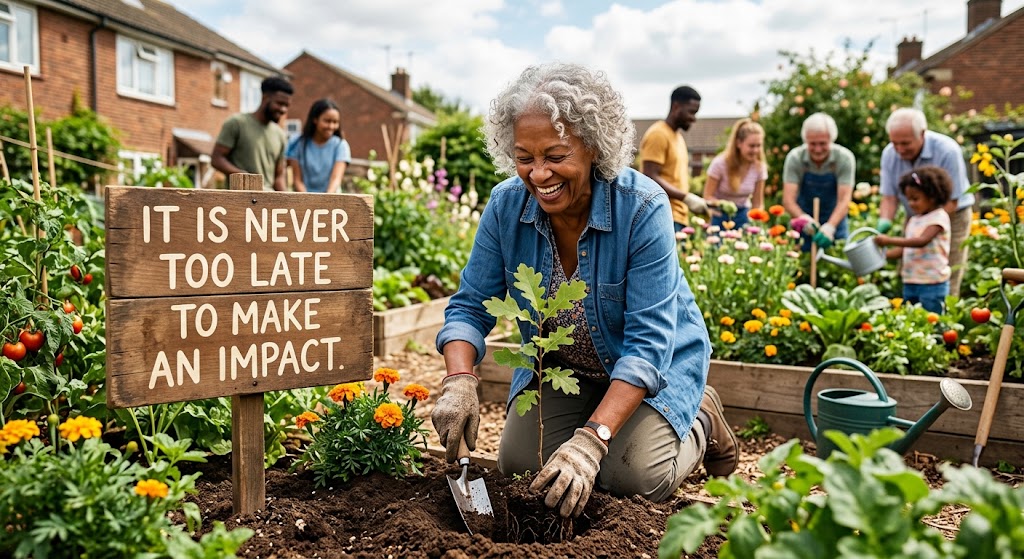
Here are 20 people who remind us that purpose has no expiry date There is a question many people begin to ask as they get older: “Is it too late for me?”Too late to start again.Too late to build something.Too late to learn something new.Too late to make a difference. At GrowMyHome, we don’t believe it is.Some of the most valuable things we can contribute come from years of experience, knowledge, relationships, and wisdom. So this newsletter is especially for the older people among us—but also for everyone who has an older person in their life. A parent, A mentor, an older sibling, A friend or A colleague.Perhaps someone who simply needs to be reminded:“You are not finished yet.” Here are 20 people whose stories show that impact can happen at any age. 1. GRANDMA MOSES — AGE 77Anna Mary Robertson Moses, better known as Grandma Moses, spent much of her life working on a farm and raising a family. When arthritis made embroidery difficult, she turned seriously to painting in her late 70s. She eventually became one of America’s best-known folk artists.Sometimes what looks like an ending is actually a new beginning. 2. COLONEL HARLAND SANDERS — AGE 62Harland Sanders had spent decades cooking and running businesses before the Kentucky Fried Chicken franchise model took off. The first KFC franchise opened in 1952, when Sanders was about 62. He then travelled extensively, selling the franchise opportunity and building the brand.Your biggest opportunity may come after decades of experience have prepared you for it. 3. HARRY BERNSTEIN — AGE 96Harry Bernstein worked as a journalist and writer for much of his life. After the death of his wife, he began writing more seriously about his childhood.His memoir The Invisible Wall was published when he was 96.You are never too old to tell your story. 4. LAURA INGALLS WILDER — AGE 65Laura Ingalls Wilder had lived much of the life she later wrote about before becoming a published author.Her first Little House book was published in 1932, when she was 65.Your past may contain the material for your greatest contribution. 5. KTHOMAS MACHASIO — AGE 55After a 22-year corporate career with SKF, including serving as Managing Director and Regional Manager for East Africa, Kenyan engineer Thomas Machasio decided at 55 to start his own business for the first time.Rather than simply retiring at 60, he chose to use his experience, knowledge and network to build something of his own. His business focused on industrial and automotive bearings while also helping customers improve the life of their machinery. His story is a powerful reminder that entrepreneurship does not belong only to the young.Sometimes, experience is the very thing that prepares you for your next chapter. EXPERIENCE BECOMES OPPORTUNITY 6. JOSEPH A. CAMPBELL — IN HIS 50sJoseph A. Campbell founded the business that eventually became Campbell Soup Company in 1869, when he was in his early 50s. The company’s famous condensed soup came later through the work of chemist John T. Dorrance.Starting later does not mean you cannot build something lasting. 7. PETER MARK ROGET — AGE 73Peter Mark Roget was a physician, scientist and scholar. His lifelong interest in language eventually became something millions of people would use.He published Roget’s Thesaurus in 1852 at the age of 73.A lifetime of knowledge can become a gift to generations that follow. 8. NGWAKA MABEL — AGE 65At 65, Ngwaka Mabel was a retired teacher living with the uncertainty of an irregular pension. Then, in 2021, she was introduced to clean-energy entrepreneurship through Solar Sister. Instead of seeing retirement as the end of her productive years, Mabel invested ₦30,000 of her savings and began selling solar products in her community.She took her products to markets, churches and community meetings, and customers also came to her home to buy. She has since built a successful business providing reliable energy solutions while achieving personal financial independence. 9. JOHN B. FENN — NOBEL PRIZE AT 85Chemist John B. Fenn continued his scientific work well into later life. In 2002, at the age of 85, he received the Nobel Prize in Chemistry for work that helped advance the analysis of biological molecules using mass spectrometry.Years of experience can produce breakthroughs that change an entire field. 10. TAIKICHIRO MORI — AGE 55Taikichiro Mori left academia at 55 after a career that included serving as a dean at Yokohama City University.He then entered the family property business and went on to build Mori Building into a major real estate company. In 1991 and 1992, Forbes ranked him the world’s richest person. His story has a special lesson for us at GrowMyHome:Retirement can be a transition, not an ending. 11. NELSON MANDELA — AGE 75Nelson Mandela spent 27 years in prison. Yet at 75, he became South Africa’s first democratically elected president. His later years were marked by leadership, reconciliation and humanitarian work.Your greatest chapter may come after your most difficult one. 12. MIGUEL DE CERVANTES — AROUND AGE 57Miguel de Cervantes experienced war, captivity, hardship and financial struggles before becoming one of the world’s most influential writers. The first part of Don Quixote was published in 1605, when Cervantes was around 57.A difficult past does not prevent you from creating something that outlives you. 13. TONI MORRISON — AGE 62Toni Morrison had already built an extraordinary literary career before receiving its highest recognition.In 1993, at 62, she became the first African-American woman to receive the Nobel Prize in Literature.Recognition may come later than expected. That does not make the work less valuable. 14. JOHN PEMBERTON — AGE 54Pharmacist and inventor John Pemberton created the syrup that became Coca-Cola in 1886, when he was about 54.He died before seeing the global company the product would eventually become.You may plant a seed whose greatest growth happens after you are gone. AGE DOES NOT DEFINE POSSIBILITY 15. FAUJA SINGH — HIS 80s AND BEYONDFauja Singh took up serious distance running in his 80s and completed his first marathon at 89.He went on to complete major marathons and became an international symbol of determination and